SPY 0DTE Options: How I Trade Zero Days to Expiry Every Morning
"0DTE" means zero days to expiration. The option dies today. That single fact changes everything about how you trade it.
I trade SPY 0DTE options almost every morning. Same model, faster tape. Sweeps, shifts, breaks, zones, compressed into hours instead of days. The edge is the sequence, executed with rules that respect how violent expiry day gets.
Most traders who touch 0DTE get destroyed by three things: hesitation, oversizing, and chasing. This post is my full morning playbook so you can avoid all three.
What 0DTE actually means (and why it changes everything)
An option with zero days to expiration has no tomorrow. Every minute that passes without price moving in your direction, time decay (theta) eats your premium. By the last hour of the day, decay accelerates hard. A contract worth 40 cents at lunch can be worth 5 cents by 3 PM even if $SPY barely moved.
That means 0DTE doesn't forgive slow decisions. Hesitation is not neutral on expiry day. It is a position against you.
The upside: no overnight risk. When the bell rings, you are flat. The price of that is speed. Every decision has to be pre-made, because live decisions on a 0DTE chart are where accounts go to die.
Why $SPY is the only 0DTE I trade
Liquidity. $SPY options are the most liquid contracts on earth. Tight spreads, instant fills, expirations every single weekday. When I need out, I am out in one click at a fair price.
I don't trade 0DTE on random names. Wide spreads on expiry day turn good reads into bad fills. And I mark my levels on ES futures, not $SPY itself, because the real swing highs and swing lows live on ES.
My SPY 0DTE morning routine
My trading day starts before the bell.
First, I mark levels on ES: yesterday's high and low, the overnight high and low, and the nearest 4H swing points. Those are my Liquidity Sweep targets for the day.
Second, I check the economic calendar. If CPI, FOMC, or a major print lands during my window, I stay out or cut size hard.
Then I wait. I do not trade the first 5 to 20 minutes. The first move is usually the fake one. I let the mini trend form, let the Liquidity Sweeps take out the early levels, then I start looking.
The first 30 to 60 minutes is where the day's high or low gets made. That is when I am active: one or two trades, max. Chasing midday on 0DTE means wider stops and shrinking premium. The edge lives in the morning.
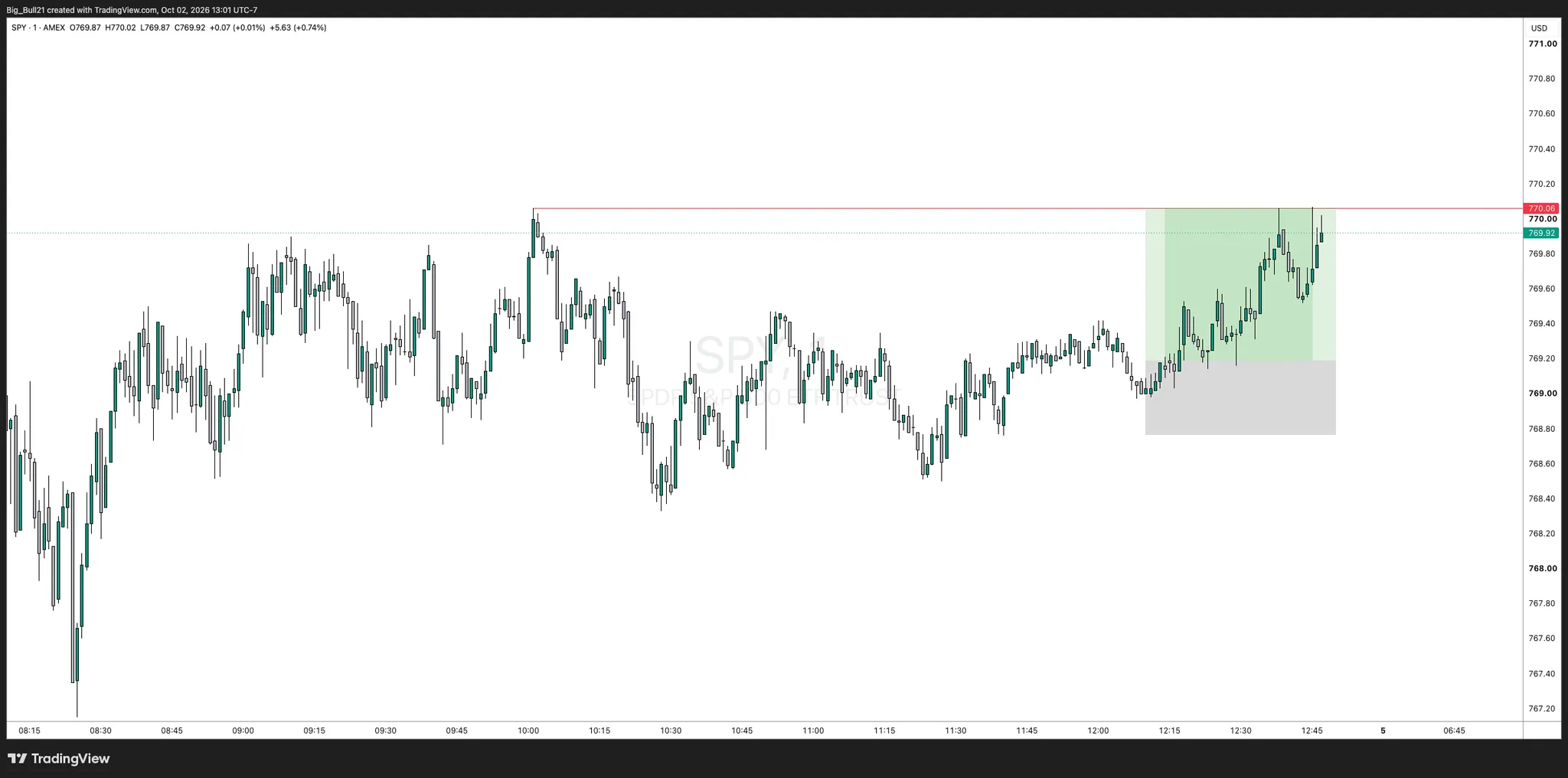
Want to watch me trade this live? I call my 0DTE entries out in real time every morning inside the free Bulls Corner Discord. Get in free here, just drop your email and you're inside.
How I pick the strike
I keep it simple. I trade slightly out-of-the-money strikes, usually 2 to 3 dollars out on $SPY 0DTE. That zone gives me the best gamma-to-cost ratio: cheap enough to multiply fast when the move comes, close enough that I don't need a miracle.
I never trade 0DTE off an hourly chart. Look at an hourly candle and your stop has to be enormous. The timeframe and the instrument have to match: hourly bias for direction, minute-level structure for entries. I trade the chart my stop actually fits on.
A worked example: one morning, one setup, flat by lunch
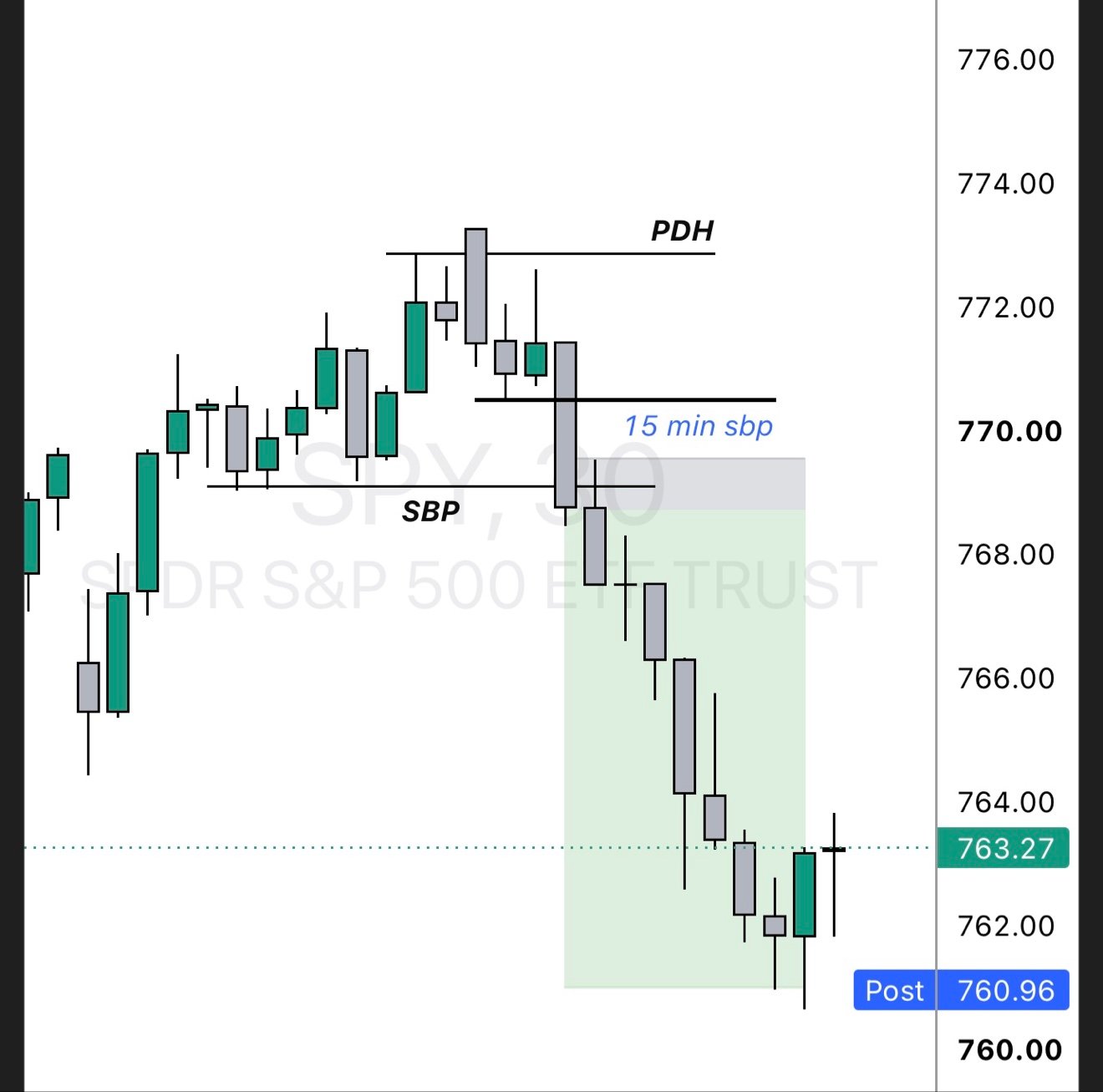
Here is how a textbook morning runs. I mark my levels before the bell: yesterday high and low, the overnight range, and the nearest swing points on ES. The open comes, price pushes up and sweeps the prior day high, taking out the stops sitting above it. The first move is usually the fake one, so I do not click. I wait for the rejection.
Then the Directional Shift prints: a strong candle closes back below the swept high. The Structure Break Point confirms on the next leg down, and I drag my fib on the break leg to find the High-Value Zone. Price pulls back into the zone, and that is where my entry lives. I take a slightly out-of-the-money strike, a few points out, with my stop, size, and target decided before the order exists.
From there the rules run the trade, not my feelings. The stop goes to breakeven once the position is comfortably green, and I scale out as the move extends. No midday chasing, no holding into the close. By the time the afternoon chop and decay arrive, I am flat, the setup is logged, and the day is done. One clean setup, executed the same way I execute it every morning.
0DTE vs weekly options
| 0DTE options | Weekly options | |
|---|---|---|
| Time decay | Extreme, every minute without movement costs premium | Slower, you can afford to be wrong for a while |
| Overnight risk | None, you are flat at the bell | Real, news can gap price against you overnight |
| Decision speed | Pre-planned only, live decisions on expiry day get punished | Room to think, adjust, and manage |
| Strike selection | Slightly out of the money, a few points out | More flexibility, more time for the move to develop |
| Best use | A morning setup you already planned, traded once or twice | Learning the model and building conviction before expiry day |
My 0DTE risk rules (non-negotiable)
These rules are the whole game. The strategy is simple. Surviving expiry day is the skill.
Same size every trade. 0DTE does not get special sizing. Faster expiry does not mean bigger bets. Volatility is not an invitation to oversize. It is a reason to stay mechanical.
Risk is decided before the click. Entry, stop, size, target. All decided before the order exists.
My stop is 10 to 30 percent of premium. On $SPY I am typically risking 10 to 20 cents to catch multi-point moves. A 10 to 30 percent stop routinely turns into 100 to 300 percent winners. Small risk in, asymmetric payoff out.
Stopped out means fully out, instantly. No "giving it one more candle" on expiry day. The stop hits, I am flat. Small planned losses beat large hopeful ones.
Two losses and I am done. Two stopped-out trades means I am not reading the tape today. I walk away. The market opens again tomorrow.
At 25 to 30 percent green, my stop goes to breakeven. I never let a 30 percent winner turn red. Half comes off at 50 percent, every time.
What kills most 0DTE traders
Hesitation. They see the setup, they wait for "more confirmation," and by the time they click, the move happened and the premium is already decaying. On 0DTE, indecision is a position against you. Pre-plan the entry in the zone, then execute.
Oversizing. The leverage feels free because the contracts are cheap. It is not free. One oversized 0DTE loser can undo a week of good trading.
Chasing midday. The morning window made the range. The afternoon is chop plus decay. Missed your setups? There is always tomorrow.
Holding losers into the close. The last 15 minutes of expiry day is a woodchipper. Premium dies, spreads widen, hope gets expensive. My exits are instant because the instrument demands it.
If you are new to this, don't start on 0DTE. Practice on 1 to 3 DTE first. The system is the same, the swings are smaller, and the anxiety is lower. Build conviction there, then bring it to expiry day.
I trade $SPY and $QQQ 0DTEs every morning and call every step out loud. The free Discord is where it happens, join free.
And if you want the whole thing, every setup, every alert, plus my full course: the 7-day free trial gets you inside Premium free for a week.
See you at the open.
Free download: Want my complete starter guide to $SPY options? Grab the SPY Options Mastery guide free here.
Watch: Hold Winning Trades Longer (Stop Exiting Too Early) | 0DTE Options Strategy Breakdown
FAQ
Is trading SPY 0DTE options good for beginners?
Honestly, no. 0DTE punishes hesitation and rewards pre-planned execution. Start with 1 to 3 DTE contracts to learn the same setups with slower decay, then move to 0DTE once you can hold winners and honor stops.
What is the best strategy for SPY 0DTE options?
The approach that works for me is directional buying on confirmed structure: wait for a Liquidity Sweep, a Directional Shift, and a Structure Break Point, then enter the pullback into the High-Value Zone with slightly out-of-the-money strikes. The risk rules matter more than the strategy: same size, pre-planned stops, hard daily loss limits.
When is the best time to trade SPY 0DTE?
The first 30 to 60 minutes after the open, when the day's high or low is typically made. I avoid the first 5 to 20 minutes (the first move is usually fake) and I don't chase midday when decay accelerates.
How many 0DTE trades should I take in a day?
One or two, max. The morning window makes the range, and after that the edge fades while decay accelerates. If I take two stopped-out trades I am done for the day, no exceptions. More trades on 0DTE does not mean more opportunity. It means more decay and more chances to force something.
What happens if I hold a 0DTE option into the close?
The last stretch of expiry day is where premium dies fastest and spreads widen. A contract that looked fine at lunch can be nearly worthless by the close even if price barely moved. My exits are instant because the instrument demands it. Never hold a 0DTE loser into the close hoping for a miracle.
Can I trade 0DTE options on tickers other than SPY?
I do not, and I would not recommend it. SPY has the tightest spreads and deepest liquidity of any 0DTE market, which is what makes fast exits possible. Wide spreads on a random name turn a good read into a bad fill. I mark my levels on ES futures and trade the read on SPY, and that is the whole universe for my 0DTE trading.
Trade this live with me
I call every step of this model out loud, every morning, inside the free Discord.
Join the FREE DiscordStart 7-day free trial
7-day free trial, then $90/mo. Cancel anytime.
Keep reading
0DTE Timing: When I Enter and When Theta Eats You Alive $QQQ vs $SPY: Which 0DTE I Trade and When 0DTE Greeks in Plain English: Delta and ThetaRisk note: everything on this blog is educational content from my own trading experience, not financial advice. Trading options involves substantial risk of loss.