The Downside PSS Model: Shorting $SPY Tops
I used to be the guy trying to short $SPY tops on gut feel.
Red candle? I'm in. Price looks heavy? I'm in. Then I'd watch it rip two points higher while my puts bled out.
That version of me donated a lot of money to the market.
Today I don't predict tops. I wait for the market to show me the top, then I short it with a plan: the Downside PSS Model. Four steps, every time.
Here it is, free.
Why most traders fail to short $SPY tops
Most traders short tops because price "looks expensive." That's fear with extra steps. $SPY can always go higher, and it loves proving that to early short sellers.
What actually turns a market around is fuel: resting buy stops sitting above obvious swing highs. When price pushes through a clear high, every breakout buyer's stop and every trapped short's stop triggers at once. FOMO buyers pile in at the worst possible price, and that's the fuel smart money needs to reverse the move down.
So I don't short the rally. I short what the rally creates.
Step 1: The Liquidity Sweep of the High
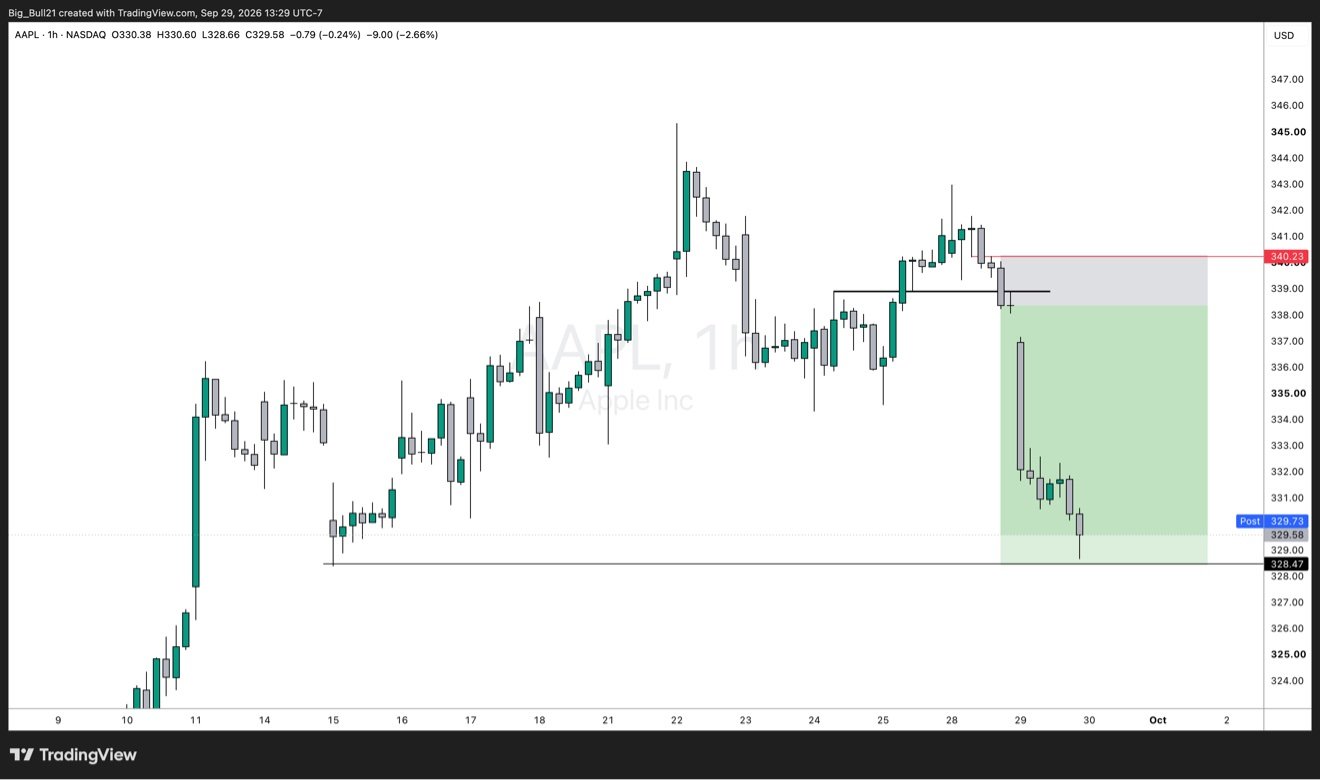
This is where everything starts.
Price pushes through a clear swing high on the higher timeframe. Retail sees a breakout and piles in long. But I don't want a breakout. I want a grab.
The candle needs to pierce the high, then snap back down and close below it. That long upper wick is the whole tell. It proves buyers tried to hold price up and failed.
My rule is binary:
- Wick above the high, close back below it: valid sweep.
- Candle body closes above the high: buyers actually won. Setup is dead. I walk away.
No wick rejection, no trade.
Want to watch me short these live? I call every sweep out in real time inside the free Bulls Corner Discord. Get in free here, just drop your email and you're inside.
Step 2: The Bearish Directional Shift (DRS)
A wick alone isn't enough. A wick says buyers failed. It doesn't say sellers took over.
On my 15m entry timeframe, I watch the last swing low, the one that pushed price up into the sweep. I need a strong candle body close below that level. Not a wick. A body close.
That's the bearish Directional Shift. Control changed hands. It's printed on the chart.
Both must pass:
- Did price power through the most recent swing low?
- Is there a solid candle close confirming it?
If yes, the reversal is real. If no, I'm flat. Patience is the position.
Step 3: The Structure Break Point (SBP)
Amateurs short the first red candle after the shift. I don't short the first dump. I wait for the market to build a staircase down.
After the bearish Directional Shift, I let price bounce and form a lower high. When price sells off and breaks below the initial DRS low, that's my Structure Break Point. Lower highs and lower lows: a verified downtrend, not a guess.
Checklist:
- Has the market printed a clear lower high?
- Did price break the previous low to confirm the SBP?
Two yeses and the reversal is confirmed. Now, and only now, do I start thinking about entry.
Step 4: The High-Value Zone Short (HVZ)
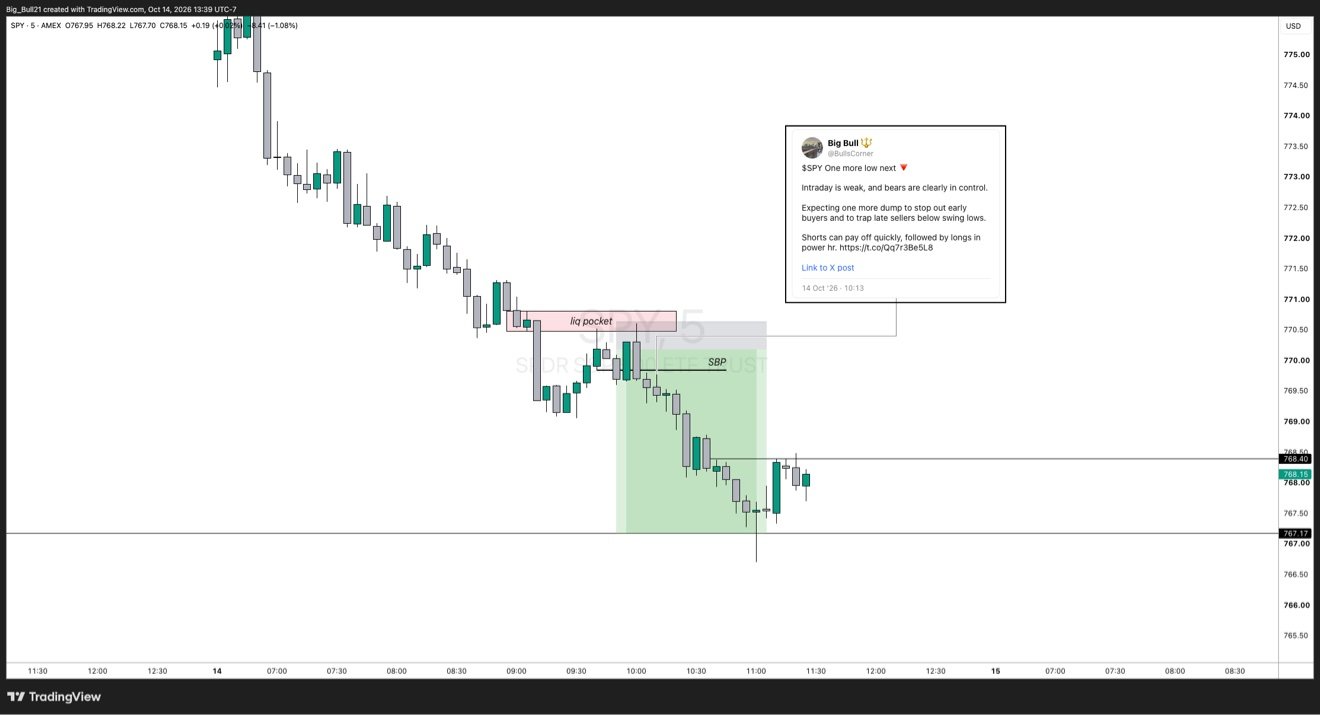
Amateurs short breakdowns. Pros wait for the bounce.
I drag my Fib from the new lower high down to the SBP low and wait for price to rally back into the 50% to 61.8% High-Value Zone. That's where I short the premium.
Execution is mechanical from here:
- Entry: the 50% to 61.8% zone
- Stop loss: above the recent lower high or the sweep high, no exceptions
- Target: the liquidity resting at the original lows
Same size every trade. A stop-out is a full exit. The model only works if you work the model.
A worked example
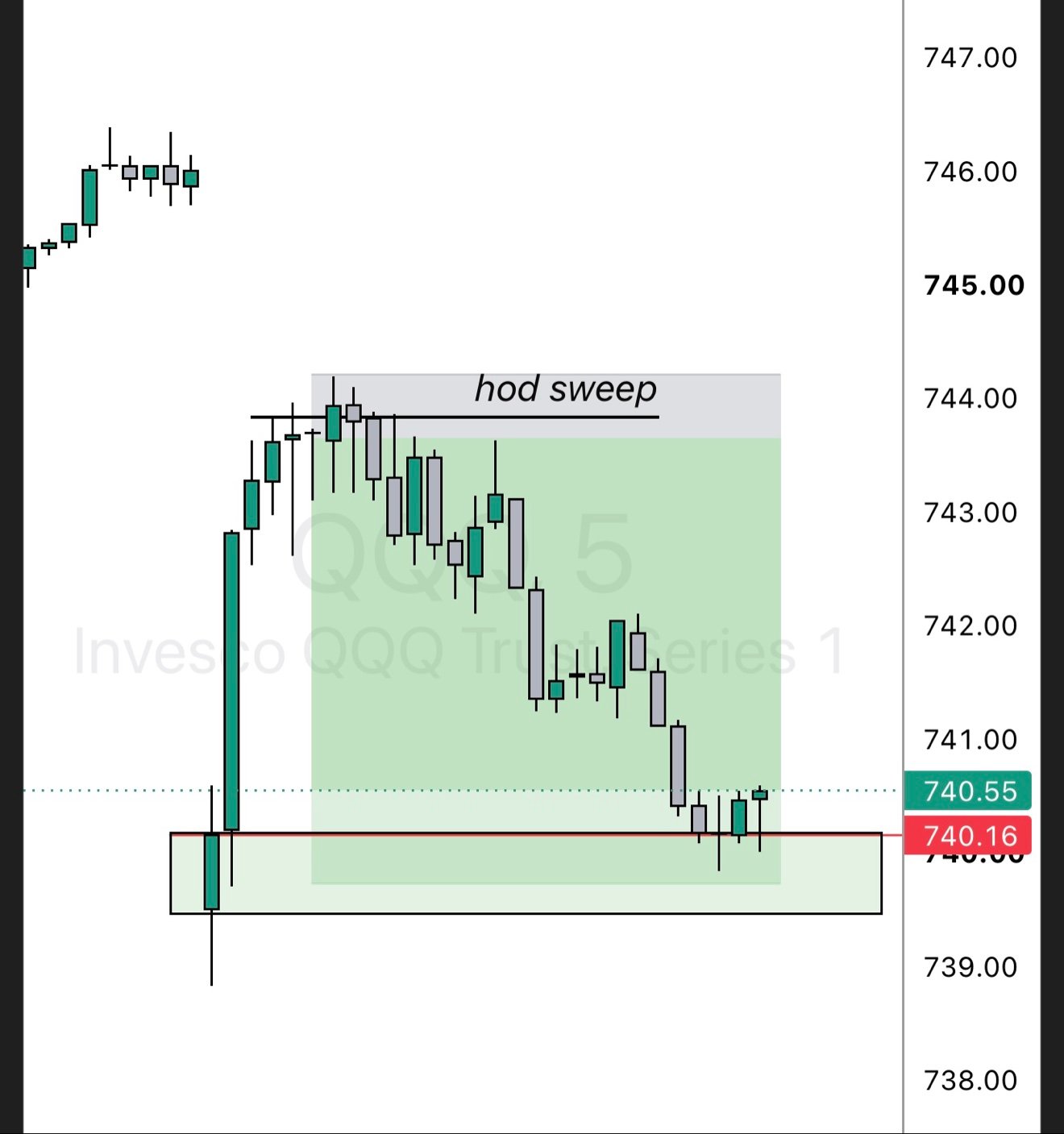
Picture a morning on the $QQQ 5-minute chart. Price grinds up into the high of the day, a level everyone can see. The next candle pushes over that high, wicks hard, and closes back below it. That is the sweep. The stops sitting above the high just got taken, and buyers could not hold price up.
Next I drop to the 15-minute chart and mark the last swing low, the one that pushed price up into the sweep. A strong candle closes through it with its body. That is the bearish Directional Shift. Control just changed hands, and it is printed on the chart, not guessed.
Then I wait. Price bounces and prints a lower high below the sweep extreme. When it sells off and breaks below the shift low, that is my Structure Break Point. Lower highs and lower lows are now on the chart, and the reversal has a staircase behind it.
Only now do I plan the entry. I drag my Fib from the lower high down to the break low and wait for price to rally back into the High-Value Zone. If it never gets there, I stay flat and I miss the move, and that is fine. If it does, I take the short with my stop above the lower high and my target at the liquidity resting below, where the rally started.
Downside vs upside: one model, two directions
| What happens | Downside PSS | Upside PSS |
|---|---|---|
| The sweep | Price wicks over a swing high and closes back below it | Price wicks under a swing low and closes back above it |
| The shift | Strong body close below the last swing low | Strong body close above the last swing high |
| The structure | Lower high prints, then price breaks the shift low | Higher low prints, then price breaks the shift high |
| The entry | Short the rally into the High-Value Zone | Buy the pullback into the High-Value Zone |
| What kills it | The sweep high gets taken out | The sweep low gets taken out |
The rules that keep me alive
The four steps are the setup. These rules are why I'm still here after six years:
HVZ entries only. If price never rallies into my zone, I don't have a trade. Missing a move costs me nothing. Forcing one costs me everything.
Same size every time. Feelings aren't a position sizing model.
Full exits on stops. When the stop hits, I'm out. The market just told me I was wrong, and arguing with it is expensive.
One model, both directions. The upside version is the exact same framework mirrored: sweep the low, shift up, break structure, buy the discount zone. Learning one setup deeply beats collecting ten shallowly.
Stop donating to the market
The PSS Model fixed that for me. Sweep traps the weak hands. Shift proves the turn. Break confirms the trend. Zone gives me the entry.
Four steps. Every time. No guessing.
If you want to see this happen live, I trade $SPY and $QQQ 0DTEs every morning and call every step out loud. The free Discord is where it happens, join free.
And if you want the whole thing, every setup, every alert, plus my full course: the 7-day free trial gets you inside Premium free for a week.
See you at the next sweep.
Free download: Want this model as a one-page PDF cheat sheet? Grab the Downside PSS Model guide free here.
Watch: Massive Move on QQQ Puts! Trade Recap & How We Nailed the Entry
FAQ
What is the downside PSS model?
My 4-step framework for shorting tops: a Liquidity Sweep of the swing high, a bearish Directional Shift (strong close below the last swing low), a Structure Break Point (lower high printed, then break of the DRS low), and a short entry in the 50% to 61.8% High-Value Zone.
How do you know a market top is actually in?
I wait for proof in sequence: the high gets swept with a wick rejection, sellers prove control with a strong close below the last swing low, then structure confirms with lower highs and lower lows. Until all three print, there is no top. There is just a rally.
Where do you place your stop loss when shorting?
Strictly above the recent lower high or the sweep high. If price reclaims that level, buyers won and my thesis is dead. The stop sits where the idea dies, not where it feels comfortable.
Can I use the downside PSS model on $QQQ?
Yes. It's identical on $QQQ, $SPY, or any liquid instrument with clean intraday structure. I trade both every morning and take whichever prints cleaner. The steps and rules don't change.
What timeframe do you trade the downside PSS model on?
I mark the sweep on the higher timeframe and confirm the Directional Shift on the 15m entry timeframe. For 0DTE scalps I execute on 1m to 15m structure. Same sequence on every timeframe, only the speed changes.
What happens if price sweeps the high but never shifts?
Then I have context and nothing else. A sweep without a shift is a story, not a setup. I stay flat and wait for the next one. The shift is the proof that sellers took over, and without it there is no trade.
Do I need all four steps before I short?
Yes, every time. The sweep traps the weak hands, the shift proves the turn, the break confirms the trend, and the zone gives me the entry. Skipping a step is how I used to donate money to the market.
What if price dumps without rallying back into my zone?
Then I miss it, and I am fine with that. Chasing a selloff means shorting with no defined invalidation and no premium. Missing a move costs me nothing. Forcing one costs me everything.
Trade this live with me
I call every step of this model out loud, every morning, inside the free Discord.
Join the FREE DiscordStart 7-day free trial
7-day free trial, then $90/mo. Cancel anytime.
Keep reading
The Upside PSS Model: Buying $SPY Bottoms Liquidity Sweeps: Why Smart Money Hunts Your Stop Loss Before the Real Move The Directional Shift: The Candle Close That Tells Me the Sweep Is OverRisk note: everything on this blog is educational content from my own trading experience, not financial advice. Trading options involves substantial risk of loss.